
Data Curation Conference 2027

DCC2027

Registration Deadline:

  • 15 December 2026

Conference Date:

  • 14 January 2027

Location:

  • Biozentrum, University of Basel

Only researchers and staff affiliated with the University of Basel can participate.

View the conference program

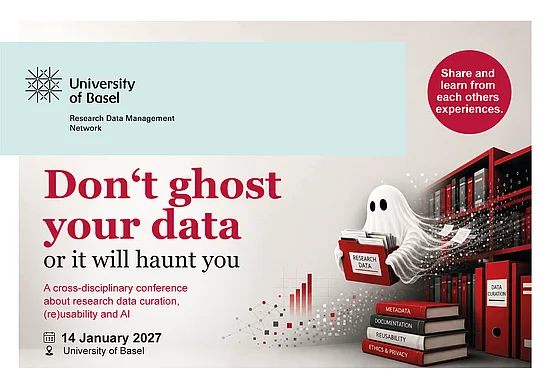
Don’t ghost your data or it will haunt you

A cross-disciplinary conference about research data curation, (re)usability and AI

Good data outlives the project it was born in. Bad data haunts it. Somewhere between those two fates sits the daily, unglamorous, surprisingly hard work of data curation—and that is what this conference is about.

High-quality data is the cornerstone of open and trustworthy research, yet keeping it valuable, durable, usable and FAIR is never a one-and-done task. The moment we try to store or publish data; the tricky questions arrive:

  • Is the documentation good enough for someone else—or future you—to actually reuse it?
  • Is this format going to be readable in ten years? Is the metadata complete?
  • Where does AI genuinely help in automating and enriching curation, and where does it quietly complicate things?
  • And how can sensitive data be curated to enable safe sharing and future reuse?

With this conference, the Research Data Management Network of the University of Basel aims to provide a space for early-career and senior researchers from all disciplines as well as research support staff at the university to share and discuss experiences, tools, and hard-won lessons—covering the technical solutions as well as the human, organizational, and ethical dimensions of managing and publishing research data in a fast-changing world.

The conference will take place at the University of Basel and is conceived as a platform for open exchange and an opportunity to learn from one another in order to improve data quality, daily research practices, and research outcomes.

Join us on 14 January 2027!

Registration

We look forward to curating a great day together!

Conference Date: 14 January 2027, 9:00-17:00

Registration Deadline: 15 December 2026

Location: Biozentrum, University of Basel, Spitalstrasse 41, 4056 Basel (Google Maps)

Call for Proposals:

  • Submission Deadline: 30 September 2026
  • Extended Submission Deadline: 21 October 2026
  • Notification of Acceptance: 15 November 2026
14 January 2027, Biozentrum, University of Basel
Room \ TimeHalle U1Hörsaal U1.101Seminarraum U1.191Seminarraum 02.073
09:00–09:30Coffee Reception & Registration   
09:30–10:30 

Welcome & Keynote

Keynote lecture by Dr. Antica Čulina

Title: Open science: between ideals and research realities

  
10:30–10:45Coffee Break   
10:45–12:00 Lightning Talks: Challenges, Ideas & Insights Workshop 1: From Raw Data to a Website for Humans
12:00–13:30Lunch Break   
13:30–14:00 

Panel Discussion: Making Data Curation Count

  • Prof. Dr. Torsten Schwede
  • Prof. Dr. Rosa Lavelle-Hill
  • Prof. Dr. Kurt Schmidheiny
  
14:00–15:00 Session 1: Curating MetadataSession 2: Enhancing ReusabilityWorkshop 2: From RDM Classroom to Master’s thesis
15:00–15:30Coffee break   
15:30–16:30 Session 3: Data Curation WorkflowsSession 4: Collaboration & SharingWorkshop 3: FAIR for Machines and Humans
16:30–17:00 Conference Wrap-Up  

You can also download a PDF version of the program (without presentation titles and abstracts) here: Schedule DCC27.

Please take a minute to register for the Data Curation Conference 2027 
Date: 14 January 2027, 9:00-17:00
Location: Biozentrum, University of Basel, Spitalstrasse 41, 4056 Basel
Language: English

Conference Program

Registration is free (including lunch and coffee breaks) and open until 15 December 2026

Please note that registration and participation are restricted to members of the University of Basel and its associated institutions.

We look forward to seeing you there!

Registration Data Curation Conference 2027

Enter your unibas email address or, if you do not have one, the email address of your choice
Your discipline (e.g., medicine, history, etc.)
Your faculty, department, institute, or another unit at the university (e.g., Faculty of Law, Department of Physics, etc.)
Your role or job position at the university? (e.g., student, PhD student, postdoc, research assistant, senior researcher, professor, service staff, etc.)

Workshops

Places in the workshops are limited. Please let us know which workshops you would like to attend and in what order of priority. We consider the priorities you have set as preliminary registrations for the workshops. You may also choose not to select any workshops (option: none). Find more information about the workshops below.

Select your first choice for a workshop
Select your second choice for a workshop
Select your third choice for a workshop

Workshops

Lars Schöbitz

Global Health Engineering, ETH Zurich

10:45–12:00 | Seminarraum 02.073

Abstract

Survey and monitoring data from the water, sanitation and health sector mostly lives in spreadsheets that only their owners can read. For five years, Global Health Engineering at ETH Zurich has turned such files into published data. Each dataset becomes an R data package with a data dictionary and metadata, archived with a DOI and presented on a website with documentation and plots. AI now does most of the mechanical work. We publish for machines and humans. This workshop is about the humans, who still have to discover, interpret and trust the data.

In this workshop we build one dataset together. Every participant contributes to it through GitHub, a little before the conference and the rest in the room, and the contributions arrive as different kinds of raw data. I then run the workflow live with the free, open source tool washr, from these raw files to a data package and its website. A coding agent performs the steps. The points where a person confirms stay visible, and so does the record of what the AI did and of who contributed what. Participants review the documentation and propose changes on GitHub. In groups we then discuss four themes the workflow raises for data curation: oversight of AI curation, disclosure of AI contributions, sensitive data, and scientific credit for data.

Participants who could imagine publishing a dataset of their own this way can tell me after the workshop, and I follow up with them.

Agenda

  • 15 min: Introduction, why we publish for humans and the workflow in one picture
  • 35 min: Building a dataset together, from the raw contributions to the data package and its website
  • 20 min: Discussion in four groups, one theme each
  • 5 min: Take home

Learning objectives

Participants will be able to:

  • Describe the stages a raw dataset passes through on its way to a published data package and website.
  • Contribute to a shared dataset on GitHub with issues and comments, and propose a change that way.
  • Tell which steps of data curation a coding agent can take over, which stay with the researcher, and how AI contributions are recorded.

Prerequisites

  • Bring your own laptop. No software has to be installed.
  • A free GitHub account. The workshop website explains how to create one.
  • By Friday, 8 January 2027: take the pre-course survey and make your first contribution to the workshop dataset on GitHub. The workshop website explains both: https://rawtoweb.github.io/website/dcc-2027/

Sarah N. Musy, Tania T. Martins, Franziska Zúñiga, Michael Simon

Nursing Science, Department of Public Health, University of Basel

14:00–15:00 | Seminarraum 02.073

Abstract

Good data curation practices should become part of how researchers work with data from the outset. But how can we introduce these practices during graduate education without overwhelming students with requirements designed for larger research projects?

At the Institute of Nursing Science, our approach to data-related education has evolved from teaching reproducible statistical analysis with R to introducing dedicated research data management (RDM) teaching in 2023. Our current challenge is moving from teaching RDM principles to supporting their application in students’ own projects. We are therefore developing practical resources for Master’s students and their supervisors, starting with a short Data Management Plan and simplified informed-consent guidance and templates. Further resources may follow as needs are identified.

In this interactive and interdisciplinary workshop, we will present our approach and initial resources as a starting point for discussion. Working in small groups, participants will identify challenges faced by Master's students, explore what practical support they need, and propose resources that could help them manage their data responsibly. Each group will prioritize its ideas and outline the purpose and content of one proposed resource.

Together, we aim to develop an initial collection of ideas for a practical student RDM toolkit, while exploring which needs are shared across disciplines and which require discipline-specific approaches.

Using nursing and health sciences as a use case, the workshop asks a broader data-curation question: How can we turn RDM education into everyday research practice from the beginning of a researcher’s career?

Agenda

  • Introduction (10 min): Evolution of our approach to RDM education and presentation of initial resources.
  • Group-work introduction (5 min): Workshop questions, objectives, and group formation.
  • Collaborative group work (25 min): Identify student needs, propose practical resources, and develop initial ideas.
  • Presentations and discussion (15 min): Share group proposals, compare perspectives, and identify priorities.
  • Conclusions (5 min): Summarize findings and discuss potential next steps.

Learning Objectives

By the end of the workshop, participants will be able to:

  • Identify common challenges and support needs related to data management in Master's research projects.
  • Explore how practical resources can help students translate RDM principles into everyday research practices.
  • Contribute ideas towards a student RDM toolkit, considering both shared and discipline-specific needs.

Prerequisites

No prior RDM expertise or preparation is required. Participants from all disciplines and at all career stages (students, PhD students, researchers, lecturers, professors, etc.) are welcome. Bringing a laptop or smartphone is recommended for contributing to the collaborative exercise.

Noémi Villars, Daniela Subotic

Swiss National Data and Service Center for the Humanities (DaSCH)

15:30–16:30 | Seminarraum 02.073

Abstract

Funders and journals now expect research data to be FAIR, and most of what that requires comes down to information only researchers can provide. What happens when that information is missing, and what do researchers gain when it is there? This workshop explores both sides in practice.

In research areas where data is often an interpretation of physical sources, reusers need more than a title and a licence. They need to know which sources the data draws on, how these were transcribed or classified, and what is uncertain. Without proper documentation, reusing a dataset can be difficult, if not impossible.

The session is hands-on. Participants work with two versions of our showcase project "Alice in DaSCHland": the full project and a deliberately stripped-down copy with no licence, vague labels and no description of the sources. We try to answer everyday questions on both versions: What does this data mean? Where does it come from? May I use this image in my own publication? Where the answers stop, we trace which FAIR principle is affected and what that means for the researchers behind the data: not being found, not being cited, or being misread.

In a second step, participants who have brought their own data (recommended but not mandatory) can check it against the same three questions. Together we turn the findings into a short checklist of what is to be done with their data to make it FAIR(er) that the participants can take home.

We don't have all the answers ourselves and look forward to the discussion.

Agenda

  • 5 min: Introduction
  • 5 min: FAIR and its principles
  • 15 min: Hands-on 1: Answering the three questions on the full and the stripped-down Alice, side by side
  • 10 min: Debrief: where it breaks
  • 10 min: Hands-on 2: Your own data or continue with Alice
  • 15 min: Final discussion and checklist

Learning Objectives

Participants will be able to:

  • Identify the necessary information that is necessary to make their data FAIR(er).
  • Check the FAIRness of their own data based on a checklist.
  • Explain what their project loses when documentation is missing: visibility, citations, and correct reuse of their data.

Prerequisites

  • Bring your own laptop.
  • No account needed.
  • Optional: your data or a description of your data/project.

Media Consent

Please note that photos and videos will be taken during the conference. We would like to use these images and videos for event documentation, academic reporting, and public relations purposes (e.g., on our institutional website, in newsletters, social media channels, and printed publications).
If you do not wish to be photographed of filmed, you will receive a differently colored name badge at the registration desk so our staff can ensure you are not included in any recordings.

Comments

Please let us know in the comment field if you have any requirements we should know of.

Share with us your experiences and practices for organizing, versioning, documenting, and enriching your research data with metadata—and making it more FAIR—as you prepare to publish them. Tell us about the (AI) tools and techniques you use for this, what has proven useful, and where you’ve encountered challenges. Off-the-cuff topics and outside-the-box thinking are welcome.

→ Download the full Call for Proposals for further details

Submission Formats

Whatever shape your contribution takes, there's a slot for it:

Lightning talk (3min) 

A short, punchy use-case from your own work. High energy, low slide-count. Perfect for sharing and discussing one idea that worked (or didn’t).

Classical presentation (10min) 

A more traditional, in-depth talk for those who want to walk the audience through a topic at greater length

Workshop session (30–50min) 

A hands-on, interactive slot to introduce your questions, concerns, preferred tools, or best practices and think them through together with the room.

This is important: we are not asking for finished, polished solutions. Half-solved problems, productive dead-ends, nagging concerns, and “here’s what’s keeping me up at night” contributions are not just welcome—they are often the most useful thing in the room. Bring your questions and difficulties. Someone else has probably wrestled with them too.

How to Submit

Send us a short abstract with a title (max. 350 words) outlining the topic(s) of your lightning talk, presentation, or workshop. Please specify your discipline, your use-case and the data curation aspect(s) you intend to focus on. We will notify you of the acceptance of your submission by November 15.

Deadline for submissions: All calls are closed.

The conference is organized by the Research Data Management Network of the University of Basel, whose goal is to provide the university’s researchers with the best possible research data management (RDM) support by bringing together data stewards, infrastructure providers, and service providers in a university-wide network. The event marks the conclusion of a two-year project phase on research data workflows and research data curation.

Location

Biozentrum, University of Basel, Spitalstrasse 41, 4056 Basel (Google Maps)

Language

The conference language will be English.

Open Access Policy

By submitting a proposal, you agree that your presentation will be made online available on Zenodo under an open license. The expected licenses are Creative Commons Attribution (CC BY 4.0 or CC BY-SA 4.0).

Code of Conduct

We are committed to a respectful and inclusive environment. The University of Basel’s Code of Conduct applies.

researchdata@unibas.ch

Organizing Committee
  • Silke Bellanger
  • Markus Bossert
  • Stephanie Heinrich
  • Nora Holländer
  • Olga Serbaeva
To top